
Riaño-Rivera AJ, Diaz Rivera A, Alvarez-Tinjacá AC, Alfonso Leyva J, Lopez-Rodriguez E, Perez-Gil J, Ospina Ramirez OL
To access the full article, click here:
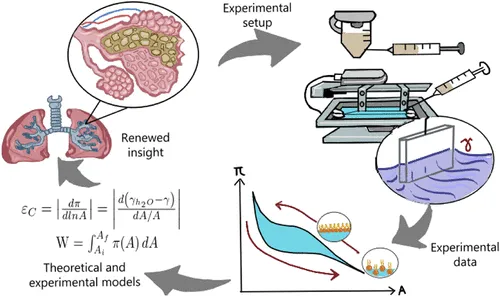
Native pulmonary surfactant (NPS) biophysical activity, reducing surface tension at the alveolar air–liquid interface and decreasing the work of breathing, is essential for life. Here we present an in vitro systematic characterization of the interfacial activity of porcine NPS films using a model air–liquid interface. For this purpose, standard surface balances were employed to measure adsorption kinetics, and the maximum surface pressure (minimal surface tension) was achieved at the end of isothermal compression. Cyclic compression and expansion of NPS films was performed under different experimental conditions, and both the surface compressive elastic modulus and the total work invested per cycle were estimated. A fourth-degree polynomial was fitted to the experimental data to obtain the compression and expansion trajectories, which were subsequently used to calculate the compressive elastic modulus at a specified pressure and, additionally, the hysteresis associated with each cycle. The compressive elastic modulus was measured before reaching the equilibrium pressure and remained essentially constant over all cycles, indicating the remarkable interfacial mechanical stability of the NPS films. The irreversibility of the thermodynamic cycles, manifested as hysteresis between compression and expansion isotherms, shows that the energy required is highest during the first cycle and decreases in subsequent cycles due to the exclusion of less stable molecular species from the air–liquid interface at high surface pressures. Taken together, the compressive elastic modulus and the hysteresis emerging from compression–expansion cycles can be considered as the functional performance metrics of pulmonary surfactant films. By focusing on the energetics and thermodynamics of compression–expansion breathing-like cycling, this approach complements traditional viscoelastic characterization and provides a functional framework to assess the stability and performance of pulmonary surfactant films.